
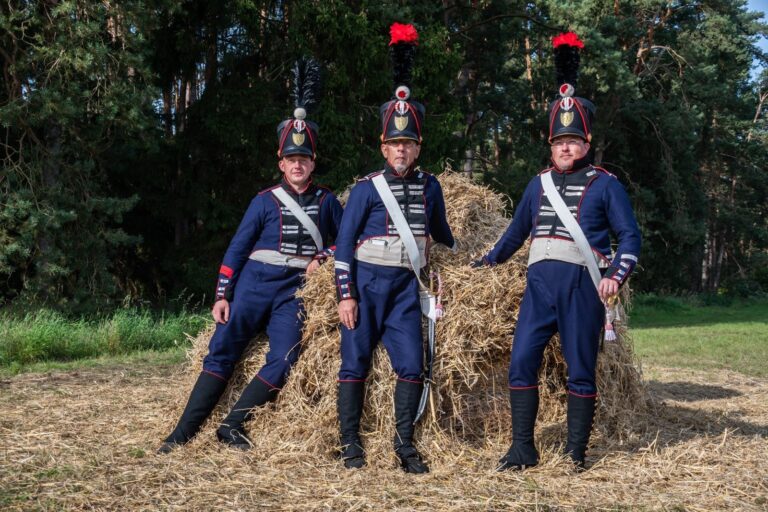
The Uniforms of the Napoleonic Wars
The period commonly referred to in reenactment and Living History as the Napoleonic Wars belongs historically to the Coalition Wars. It includes the revolutionary phase, the Republic and the First Empire under Napoleon Bonaparte. During this period, not only military tactics and equipment changed significantly, but also the uniforms of the troops, influenced by war experience and changes in fashion.
Fabric note: For historical uniforms, colour and appearance are not the only important factors. Weight, handle, weave and fabric quality are also decisive. Suitable areas include uniform fabrics, broadcloth & loden, cavalry twill and diagonal twill.
From white to blue: the evolution of infantry uniforms
A striking example of the changes in this era is the transformation of French infantry uniforms. While the royal army was dominated by white uniforms, the Revolution and the subsequent merging of the professional army with volunteer units brought a change in colour.
The new volunteer units received blue uniforms, and the light infantry regiments previously dressed in green were also changed to this blue.
This adjustment was not only a symbolic break with the monarchy, but also a practical decision: blue was a colour that could be produced more easily in mass quantities and proved more durable in field use.
Increasing centralisation and standardisation of the military under Napoleon led to uniforms being issued to the regiments with binding colour samples and pattern pieces. While considerable differences between regiments still existed at the beginning, as many commanders enforced their own preferences, stronger standardisation prevailed during the Empire.
Rank-dependent colour variations and fabric quality
Although blue was established as the basic colour for line infantry, numerous shades existed within the troops. These variations resulted from different fabric qualities as well as the dyes used.
Particularly noticeable was the gradation of colour intensity according to rank: the higher the rank, the darker and more intense the blue became, while the red used for collars, cuffs and facings appeared brighter among higher ranks.
In addition, the fabric used for officers was finer and more densely woven, with a more refined nap. The lining of uniforms also differed according to rank and unit. While ordinary soldiers wore coarse, thick wool lining, higher ranks often used a finer diagonal twill.
For reenactment and Living History: Especially with uniforms, it is worth looking closely at fabric weight, shade and weave. For some projects a finer fabric is suitable, while others call for a deliberately coarser or less brilliant quality.
The challenges in reenactment
Today, almost all surviving original uniforms are based on those of non-commissioned officers and officers. Since these pieces were made from higher-quality fabrics with darker blue and brighter red, an unintended tendency has developed in the hobby.
Most replicas are based on these uniforms, meaning that the simpler variants worn by ordinary soldiers are rarely represented. This leads to a certain distortion in presentation, as the actual soldiers of the Napoleonic Wars often wore less brilliant and coarser fabrics.
In addition to line infantry, other units also had their own colour schemes. Guard regiments and cavalry often differed greatly in their shades of blue or wore completely different colours, underlining their exclusivity.
Conclusion
The uniforms of the Napoleonic Wars reflect the social and military changes of this turbulent era. From monarchical white to revolutionary blue uniforms, a new identity emerged that brought not only visual but also practical advantages.
Today, it is a challenge for reenactors and Living History interpreters to reproduce the many colour and material variations accurately. High-quality reproductions benefit from careful research and suitable fabrics.
Suitable fabrics and further information
If you are looking for fabrics for a historical uniform, reenactment project or textile reconstruction, please feel free to contact us.