
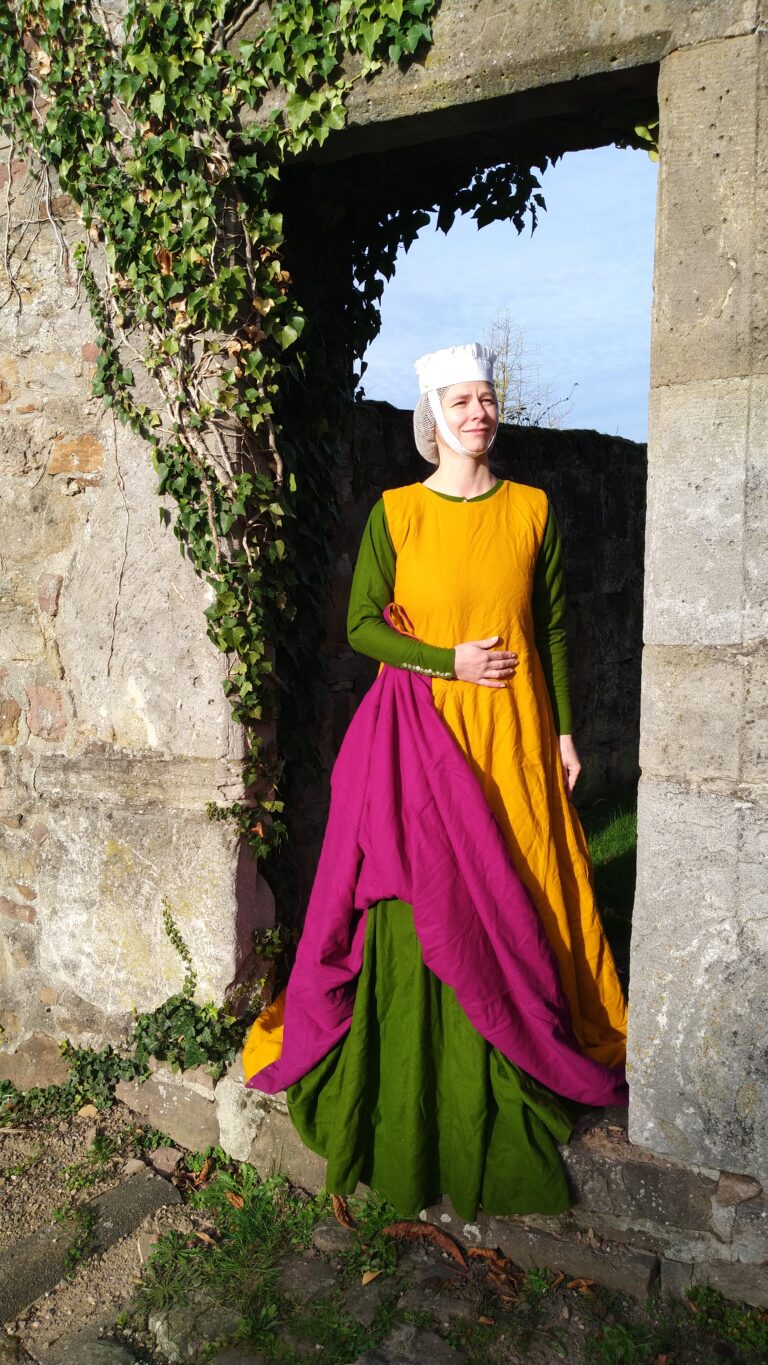
Late Medieval Fashion and Fabrics
The late Middle Ages cover roughly the period between 1300 and 1500, although some definitions place the beginning only after 1350. Fashion developments can already be observed from around 1300. While clothing in the High Middle Ages was often based on simple rectangular cuts and body shape was mainly emphasised by belts, this changed significantly in the late Middle Ages. Men’s and women’s fashion increasingly developed in different directions, and new techniques made more refined cuts possible.
Buttons, lacing and body-conscious clothing
One of the most important innovations of this period was the renewed or increased use of the button. Its use made it possible to wear garments closer to the body. Especially on the arms and upper body, buttons created a more fitted silhouette. This development was reinforced over time by lacing, hooks and eyes, so that clothing fitted even more closely and emphasised the body shape more strongly.
While women’s fashion remained long, but became increasingly body-conscious and sometimes showed the beginning of necklines, men’s clothing became drastically shorter. During the late Middle Ages, the male cotte became so short that the braies worn underneath became visible. This led to the development of hose, originally consisting of two separate leg pieces, into a connected garment – a precursor of modern trousers.
Fabric note: For closer-fitting historical clothing, drape, handle and weight are especially important. Depending on the cut, wool fabrics, linen fabrics or fibre blends may be suitable.
Colours and materials – a new variety
In terms of colour, the late Middle Ages did not differ completely from the High Middle Ages, but with the rise of towns and the growing wealth of urban classes, the demand for finer fabrics increased. While previously mainly the nobility had access to high-quality materials, wealthy citizens could now also wear coloured and more elaborately processed fabrics.
Expensive dyes such as cochineal for intense red or saffron for bright yellow were especially sought after. But dyed fabrics were also common in simpler social groups. Plant dyes such as madder root for red tones, weld for yellow and woad for blue made a wide range of colours possible and contributed to the Middle Ages being a colourful period overall.
Fine fabrics for higher demands
In addition to wool, the main material for clothing, linen also became increasingly important. Linen fabrics were especially popular in summer because they were breathable and pleasant on the skin.
Wealthy citizens and nobles also had access to luxurious materials such as silk and fine wool fabrics. Silk was extremely expensive and usually came from the Orient. High-quality wool fabrics were woven in finer weaves, making them smoother and more comfortable to wear than the coarse fabrics of the early Middle Ages.
For finer garments: Depending on the project, Italian fine linen, muslin, diagonal twill or fibre blends can be a good basis.
Conclusion – fashion awareness in the late Middle Ages
The late Middle Ages were by no means a dull period, but a time of fashion experiments and social change. Growing prosperity made new trends possible, which were further developed in the early modern period. Whether for reenactment, theatre, LARP or museum projects, suitable fabrics make it possible to create garments inspired by historical models.
What matters is not only the colour, but also material, handle, weave, weight and the planned cut.
Suitable fabrics and further information
- Wool fabrics
- Linen fabrics
- Muslin
- Italian fine linen
- Diagonal twill
- Fibre blends
- Wool fabric knowledge
- Care instructions
If you are unsure which fabric suits your late medieval garment, please feel free to contact us.